
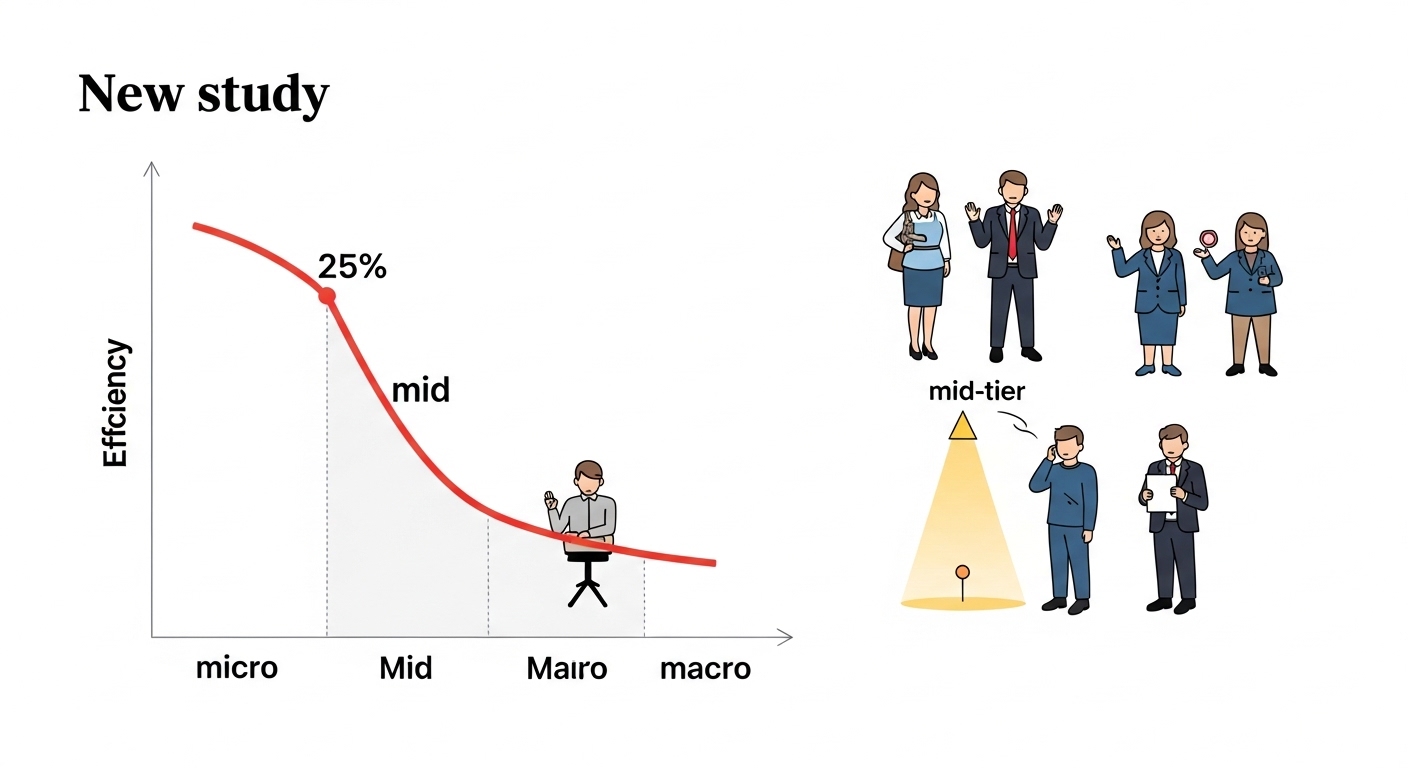
A new analysis by influencer marketing platform OpenSponsorship reveals that mid-tier influencers, those with 50,000 to 250,000 followers, deliver the lowest efficiency in terms of cost per view (CPV) and cost per engagement (CPE) compared to any other influencer category. Based on data from 1,527 paid creator campaigns executed on the platform between January 2025 and June 2026, these findings challenge the common perception that mid-tier influencers are a stable and reliable choice for marketing efforts.
Mid-Tier Influencers Show Lowest Return on Investment
According to OpenSponsorship's study, mid-tier influencers recorded the highest Cost Per View (CPV) at $0.19 across all categories. Their Cost Per Engagement (CPE) stood at $7.07, more than double that of nano and micro-creators. This inefficiency was consistently observed across 513 campaigns within this tier, representing the study's second-largest sample size.

This analysis directly contradicts the industry's common assumption that many brands consider mid-tier influencers a 'safe' option, offering substantial reach and engagement at a reasonable cost. The data clearly indicates that mid-tier influencers represent one of the most inefficient areas for marketing budget allocation.
Reach and Engagement: Contrasting Efficiencies Across Tiers
The study measured two key metrics—reach efficiency (CPV) and action efficiency (CPE)—across different follower sizes, revealing distinct variations by tier. For pure reach, mega-influencers (over 1 million followers) offered the lowest median cost per view at $0.07. In contrast, nano-influencers (under 10,000 followers) recorded a CPV of $0.13. This finding challenges the conventional belief that smaller creators are inherently better for reach.
However, when examining content reach relative to audience size, nano-creators generated views equivalent to 19.9% of their follower count, whereas mega-creators achieved only 1.1%, an 18-fold difference. In terms of engagement, smaller influencers showed a clear advantage. Micro-influencers (10,000-50,000 followers) had a CPE of $3.05, and nano-creators recorded $3.11. This contrasts with mega-influencers at $5.00 and mid-tier influencers at $7.07, indicating that the cost per action for smaller creators was approximately 40% lower.
Influencer Collaboration Costs and the Volatility of Large Contracts
The median cost per influencer collaboration consistently increased with follower count. Nano-influencers cost $134, micro-influencers $150, mid-tier influencers $417, macro-influencers $517, and mega-influencers $2,727. OpenSponsorship noted that the actual cost for mega-influencers is significantly lower than the frequently cited figure of $50,000.
Furthermore, the study analyzed data by expenditure size. Large contracts exceeding $7,500 had an average CPV of $0.41, four times higher than the $0.10 CPV for contracts under $500. Within this high-expenditure segment, CPV showed significant variability, ranging 18-fold from $0.065 to $1.18. OpenSponsorship concluded that a single large contract carries a high degree of unpredictability, akin to a 'gamble,' while a portfolio of several smaller contracts offers comparatively higher predictability.