
A recent study reveals that nearly half of brands are incorrectly pricing their creator partnerships. According to new research by Billion Dollar Boy, 45% of brands are either overpaying or underpaying creators compared to market value. This discrepancy is attributed to inadequate pricing and management systems that haven't kept pace with the rapid expansion of the creator economy.
45% of Brands Admit to Cost Errors, Highlighting Manual Management Limitations
Billion Dollar Boy's report, 'Priced on Guesswork: The State of Creator Investment,' surveyed 1,000 marketing and procurement decision-makers across the U.S. and UK. The study found that 45% of respondents admitted to mispricing creator partnership costs. This issue was more pronounced in the UK, where 58% reported errors, compared to 33% in the U.S. Among those who mispriced, 40% overpaid, while 36% underpaid, indicating problems in both directions.
The report identified the fundamental cause of these problems not as the creator costs themselves, but rather the tracking and management processes. A significant 73% of respondents stated they manage creator finances manually; 49% rely on spreadsheets, and 24% use emails and shared files. Only 21% utilize purpose-built software. The report warns that as brands scale up to work with hundreds of creators simultaneously, the absence of integrated systems can turn small pricing discrepancies into recurring overspending.
Uncertain Negotiation Skills and Eroding Trust
This gap in cost tracking and management has led to a decline in confidence among brand decision-makers. Only 44% of all respondents expressed complete confidence in their organization's ability to negotiate fair market rates. Nearly all respondents (99.7%) raised at least one operational or strategic concern regarding creator budgeting and pricing. Key issues included balancing payments against budget (57%), determining fair pricing independently (56%), demonstrating internal ROI (49%), and managing budgets across multiple markets (49%).
Furthermore, most brands appear to conduct negotiations without professional external support. 81% of respondents handle creator fee negotiations in-house rather than through an agency, with 21% stating these are managed by a separate internal team. This internal focus affects trust in negotiation capabilities: 60% of respondents showed high confidence in rates secured by external agency partners, whereas confidence in rates set by their own internal teams was only 40%.
Leveraging Platforms to Enhance Creator Investment Efficiency
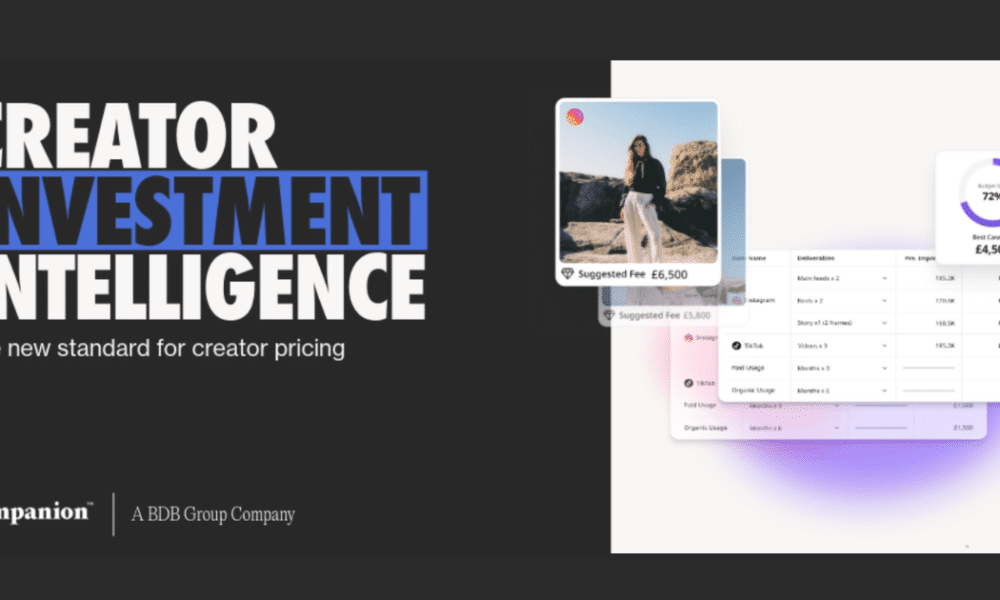
Becky Owen, CMO of Billion Dollar Boy, emphasized that these findings highlight a 'scaling problem' rather than a 'cost problem.' She explained, 'This issue has arisen because creator investment has grown faster than the systems designed to price and manage it.' To address this, Billion Dollar Boy, through its group company Companion, has launched a new pricing and budget management platform called 'Creator Investment Intelligence.'
This platform is built on data from over 180,000 verified creator transactions and $173 million in campaign spending across more than 50 regions. It includes a Benchmark Algorithm that generates suggested fees by adjusting for various variables such as platform type, deliverables, usage rights, exclusivity, region, and performance. It also features a Budget Tracker, which consolidates creator spending across multiple teams and markets into a single dashboard.
The Growing Creator Economy: Urgent Need for Robust Systems
The study clearly demonstrates the need for systematic management that brands face within the rapidly expanding creator economy. Manual approaches and a lack of specialization lead to cost discrepancies and inefficiencies, ultimately eroding trust in creator investments.
Therefore, it is urgent for brands to move beyond simply paying creators and instead establish professional systems that can fairly and transparently evaluate and manage their value. This will be a crucial foundation for building sustainable relationships with creators and maximizing the efficiency of marketing investments.