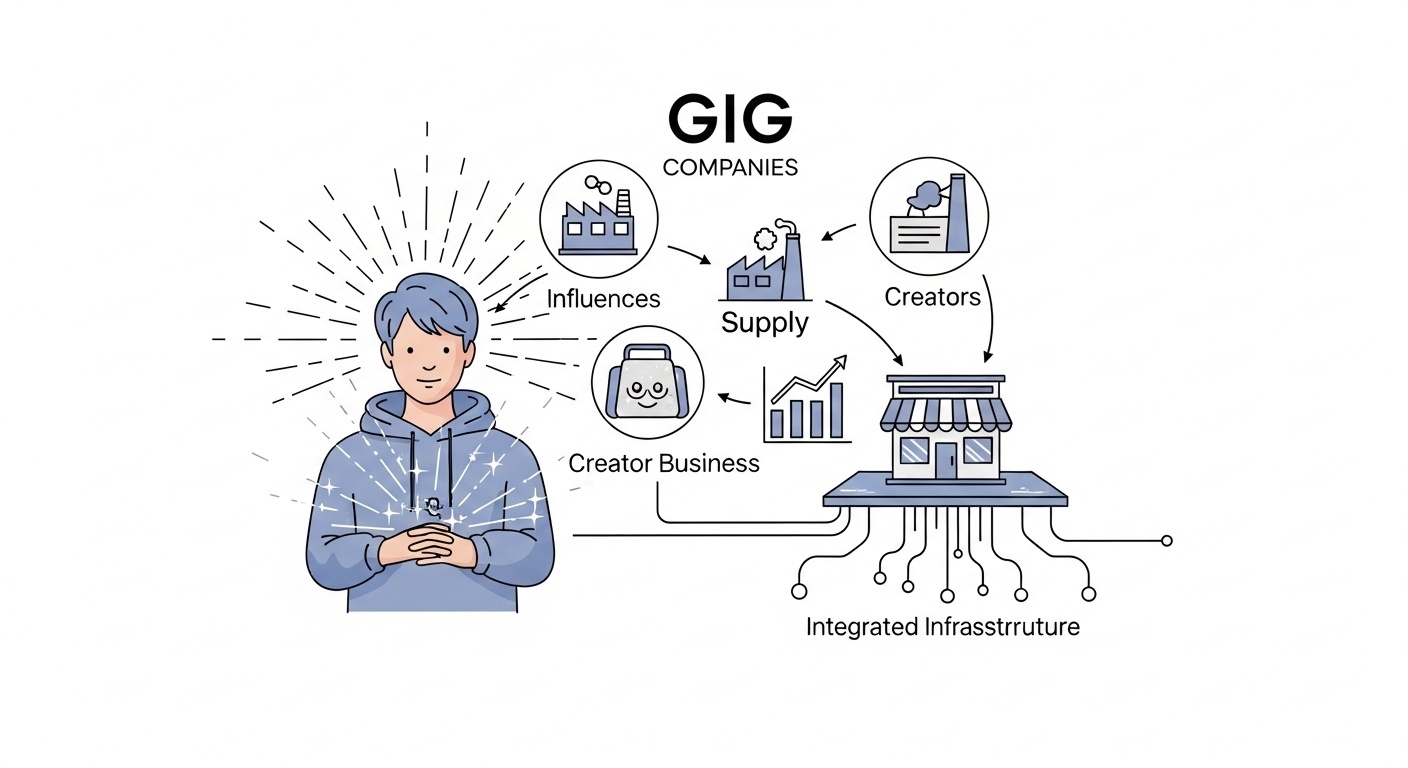
In the creator economy, many creator brand products appear successful at launch but often face ongoing failures due to operational and supply chain challenges. GIG Companies aims to solve these issues by offering integrated infrastructure and capabilities, enabling creators to move beyond simple partnerships and achieve full business ownership.
Integrated Solutions for Creator Business Ownership
GIG Companies, established in 2019, has positioned itself as a full-service venture builder for creators and talented individuals. They observed that while creators possess vast potential audiences and influence, they often lack a comprehensive team to support the entire process from idea conception to market launch and subsequent operations. GIG aims to resolve the inefficiencies creators face when working individually with multiple vendors by providing integrated capabilities to handle all aspects in-house: due diligence and validation, product development, supply chain and manufacturing, creative and brand development, go-to-market strategy, and ongoing operations.
Gary John, GIG's founder and CEO, has over a decade of experience in branding and manufacturing, leading various industries and product categories. His encounter with influencer marketing made him realize that creators, despite effectively driving customer acquisition, often only achieve short-term profits and lack long-term ownership. With this insight, Gary John founded GIG to offer turnkey integrated solutions, empowering creators to evolve from affiliate revenue models into true business owners.
The Importance of Entrepreneurial Mindset and Operational Capability
Gary John attributes the failure of creator brand products not simply to a "bad product," but to creators tending to neglect their "entrepreneurial" role after launch, refocusing on their core creative activities. He emphasizes a clear understanding of the distinction between pursuing a creative career and operating a company, highlighting that operational discipline and a "treat every day like launch day" mindset are crucial for success. Indeed, highly profitable creator businesses often maintain the initial launch energy and operational discipline over extended periods.
Furthermore, Gary John explains that not every creator needs to manage operations directly. Some successful creator brands choose to focus on their creative work while delegating operations to a strong management team, thereby significantly growing their businesses. Therefore, a critical criterion for GIG is to clearly distinguish early on whether a creator wishes to "own" a business or "operate" a business.
Thorough Feasibility Validation and Infrastructure Building Before Product Launch
GIG considers product development as just one of many elements required to bring a consumer brand to market. Numerous processes are necessary for a creator's vision to become a viable business, including brand naming, packaging, unit economics analysis, manufacturing negotiations, vendor vetting, logistics, and import planning. These processes can be particularly complex for creators who lack experience managing multiple vendors simultaneously. GIG aims to completely eliminate this coordination burden by integrating these capabilities in-house.
Before entering the development phase, GIG conducts a thorough validation process, including market research, category analysis, supply chain evaluation, and financial modeling. A particular emphasis is placed on unit economics (the difference between manufacturing costs and retail prices, margin viability, and projected operating expenses). Gary John notes that many creator product lines are designed for an impactful launch but ultimately fail due to fragile business structures. Unprofitable products, he asserts, are merely expensive hobbies. Thus, GIG focuses on first designing a financial roadmap and then building attractive products upon it. This approach also leverages creators' existing data (brand collaboration performance, affiliate sales history, customer demographics) to identify high-potential categories and price points.
The Growing Need for Infrastructure in the Era of Creator IP
Gary John analyzes the current importance of creator IP (intellectual property) as similar to the situation when affiliate marketing emerged as a primary revenue source in the creator economy. Just as management companies then rapidly needed to acquire expertise in creators' affiliate revenue activities, creators now expect managers and management companies to possess IP capabilities that can help them evaluate and execute product businesses. This is akin to an "arms race," with major agencies and management companies striving to build creator IP capabilities.
However, while Gary John anticipates that creator IP will become an industry standard, he emphasizes that not all creators are suited for product businesses, nor is every category the right choice. He observes that the current pace of discussion surrounding creator IP is outpacing the development of infrastructure capable of responsibly supporting it. GIG Companies believes that providing a repetitive and integrated infrastructure is the key solution to ensure creator ventures, which cannot sustain themselves merely through product design or brand identity, can move beyond their initial product cycle.
GIG Companies' approach demonstrates the evolution of the creator economy from mere influencer marketing towards establishing sustainable business models. By converting creators' creativity and influence into business assets and providing integrated infrastructure to solve complex operational and supply chain issues, GIG is laying the foundation for creators to grow into true entrepreneurs.
Moving forward, the importance of creator IP will only increase, and robust infrastructure and operational support will be critical factors determining the success of creator businesses.