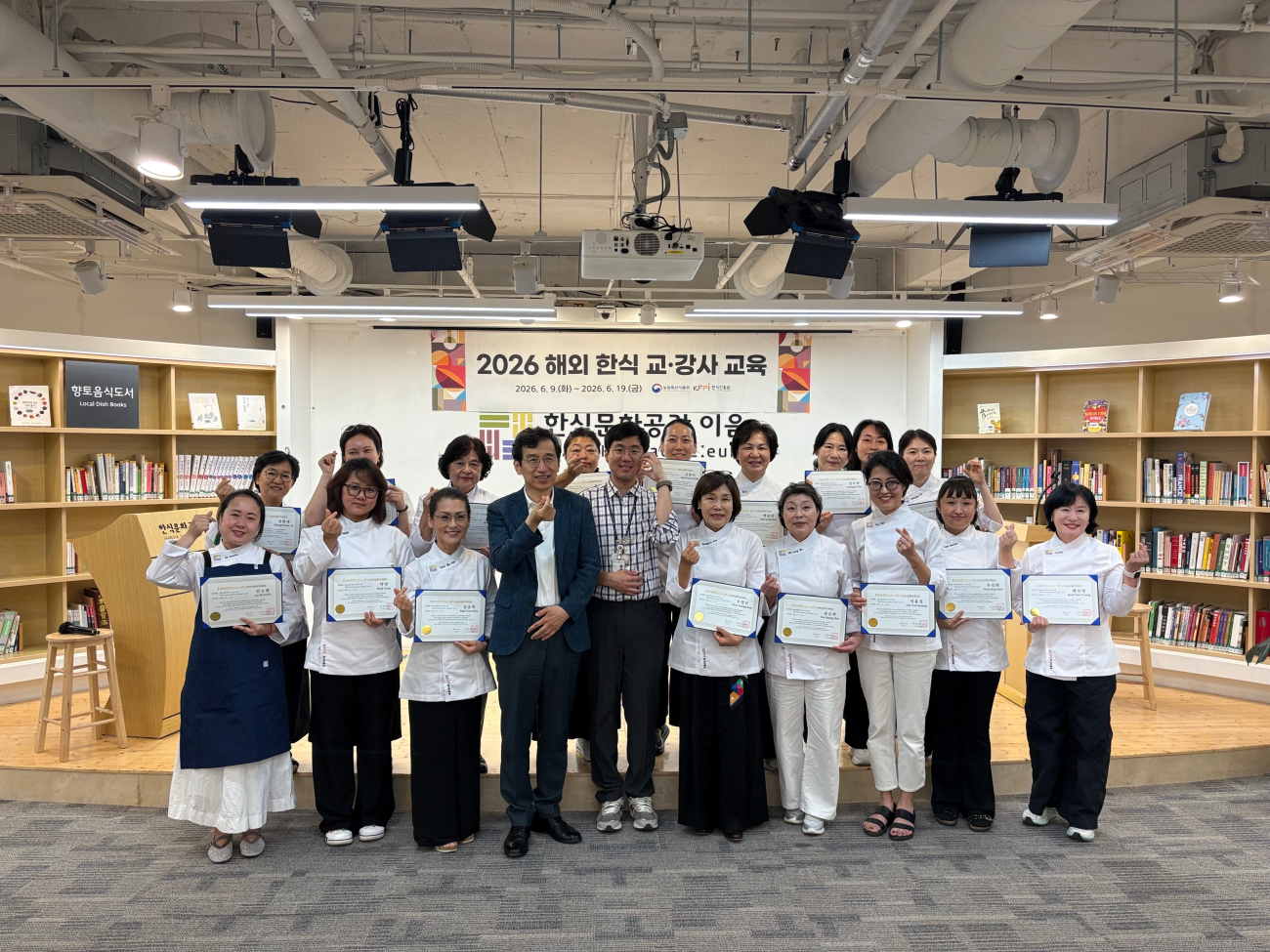
The Ministry of Agriculture, Food and Rural Affairs and the Korean Food Promotion Institute have announced the successful conclusion of the '2026 Overseas Korean Cuisine Instructor Training' program. Held from June 9 to 19, the program trained 16 overseas Korean food instructors from 11 countries, focusing on enhancing their expertise to promote Korean food culture globally. This year's training marks a significant revival, being the first in three years since 2023, underscoring the importance of nurturing experts to advance the globalization of Korean cuisine.
Successful Revival of Overseas Korean Food Expert Training
The Ministry of Agriculture, Food and Rural Affairs and the Korean Food Promotion Institute reaffirmed their commitment to the globalization of Korean cuisine by successfully concluding the '2026 Overseas Korean Cuisine Instructor Training' held from June 9 to 19. Since its inception in 2017, the program has produced a total of 370 experts by 2025, with 80 of them being overseas Korean food instructors. This year's training holds particular significance as it marks its return after a three-year hiatus since 2023.
Sixteen trainees from 11 countries were selected through a rigorous screening process to participate in this training. These instructors serve as vital ambassadors, educating local residents abroad about Korean cuisine and promoting Korean food culture. Over nine days, the trainees completed an intensive 52-hour program, significantly enhancing their professional capabilities.
Comprehensive Theoretical, Practical, and Field Trip Programs
The '2026 Overseas Korean Cuisine Instructor Training' featured a diverse curriculum, including theoretical lectures, practical sessions, and field trips, aimed at substantially boosting the participants' skills. Instructors with specialized knowledge in Korean food and the broader food industry delivered in-depth learning experiences. Theoretical topics covered a wide range, such as trends in Korean food and dining, the latest trends in traditional Korean alcoholic beverages (傳統酒), regional specialties (鄉土음식), global event trends, the culture of fermented foods (發酵음식), Korean food styling, curriculum design and material development for Korean food education, and Korean cuisine found in ancient literature.
Practical sessions offered participants the chance to experience the depth and diversity of Korean food through activities like preparing dishes using *jang* (Korean fermented sauces/pastes), traditional *bojagi* (wrapping cloth) packaging, and temple food preparation. Furthermore, trainees gained firsthand insight into the history, present, and future of Korean cuisine by visiting sites such as Goobonil Fermentation in Paju, the Institute of Korean Royal Confectionery and the Institute of Korean Royal Cuisine in Seoul's Jongno District, and the K-Gourmet Ginseng Belt in Geumsan, South Chungcheong Province.
Continuous Efforts to Drive the Globalization of Korean Cuisine
Lee Gyu-min, President of the Korean Food Promotion Institute, emphasized the importance of the training's outcomes, stating, "It served as an opportunity to improve the skills and enhance the capabilities of overseas Korean food instructors in their respective countries." The training focused on providing participants with practical knowledge and techniques necessary to effectively convey the value of Korean cuisine and integrate it harmoniously with local food cultures.
The Korean Food Promotion Institute plans to continuously activate and expand overseas Korean food instructor training programs, dedicating its efforts to the development and globalization of Korean cuisine. The institute aims to strengthen the network of Korean food experts operating abroad and provide diverse support to enable them to play a pivotal role in promoting the excellence and charm of Korean cuisine worldwide.